
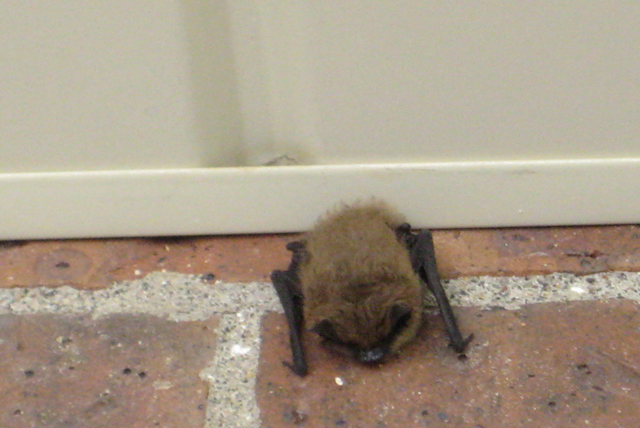
I caught this Little Brown Bat sleeping on the wall outside my office. Why he chose to sleep here, under the roof of a very busy campus is known only to the bat. He only stayed the one night day. So I felt lucky to take his photograph.
Bats are beneficial and generally a gentle species, they can also be a nuisance if they decide to take up residence in your home or outbuildings. But that’s another story for another time.
One Little Brown Bat can eat up to 1,000 mosquitoes in an hour. YEA!!!! Mosquitoes are really bad this year, and with the threat of West Nile Disease in our area having Little Brown Bats swooping along eating the nasty little bugs is pretty cool.
Yes, I know bats can carry rabies, but very few bats are ever really infected with the disease — like less than 1% of all the bats in the world get the disease.
Bats also feed on mosquitoes, Gypsy moths, Japanese beetles and other nasty damaging pests.
Bats also pollinate plants such as the Organ Pipe and Saquaro (I hope I spelled that right) cactus in the western states and like birds disperse seeds in the rainforests, encouraging new growth.
Some fun little facts about bats are:
- Bats are clean and like to groom themselves
- More than 1,000 species of bats are known
- Most bats give birth to one ‘pup’ each year
- Bats live around 20-30 years
- And my little friend up there on the wall—Little Brown Bats have a life expectancy of up to 40 years
Pretty Cool, don’t you think!?!
If you would like to learn more about bats contact the Bat Conservation Internation group http://www.batcon.org/ here you will learn how to attract bats by building your very own bat house (or two) http://www.batcon.org/index.php/get-involved/install-a-bat-house.html or maybe buy one to place near your gardens.
Wisconsin and Minnesota are setting the example by working to encourage people to understand bats. Wisconsin DNR offers free bat house design and instruction www.DNR.state.wi.us. Minnesota DNR also has plans and instructions available http://www.dnr.state.mn.us/index.html
Have fun watching these friends of our enviroment. They really are cool little creatures!
Linda
 Life on a Colorado Farm