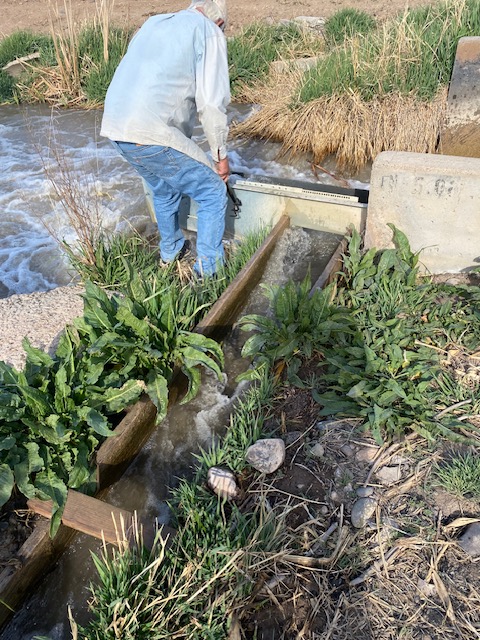

Before we could begin a big wind storm from Utah hit our area bringing with it 45-60 mile an hour wind.
Step 7 has many, many parts to it:
1. Call the ditch rider so the water can be turned into your head gate. This is the amount of water you are allotted per season. You can NEVER go over this amount, but they can cut you short of your amount because of drought. You still pay the same, whether you get your full amount or not (and water here, costs more than the taxes on the farm.)
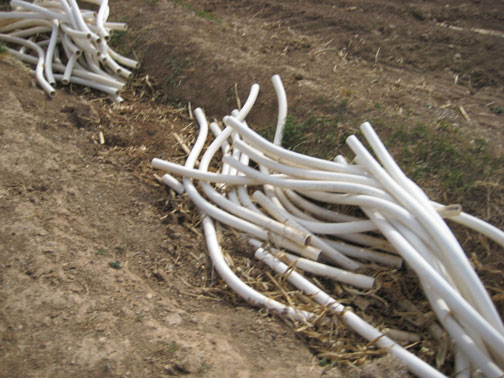
2. Gather up all the siphon tubes and lay them out in the correct pattern
3. Turn the water down the main ditch artery for our place- once it is turned into this ditch, that ditch will always have water in it until the end of the growing season.
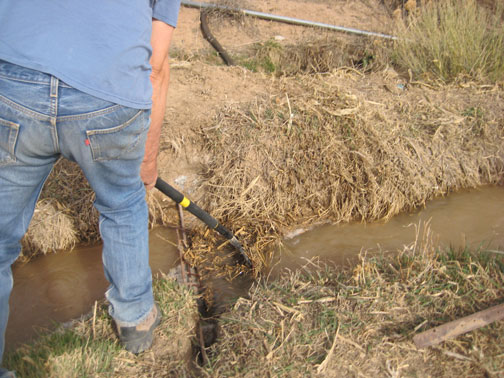
4. Although we cleaned the ditch (by hand-called digging out the ditch) the really messy wind had filled it back up with trash
5. Set the tubes. This requires a siphon like action. I have to put the tubes in the ditch, cover up one end and then hurry and spill it over the side.
Terry just walks along and covers one hand over the end, pumps two times and drops the tube in the furrow. I take forever; he is done in a short time. THEREFORE I set the tubes in the furrow, while he siphons the water into the furrows. We try to have enough tubes that once they are set we don’t have to pack them again. But every year we have to replace tubes as they wear out or get broke. Some years we just pack the tubes as that is a cheaper way to go.
Depending on the field there are about 30-40 tubes per field. It also depends on the amount of water in the ditch. Sometimes we double tube, but that is later on in the season.

6. The water is moved after the proper amount of ‘subbing’ has taken place. And the water has made it to the end of the field. Usually about a 12 hour set. But when water is short it is moved every 8 hours, day and night to get it through all the crops.
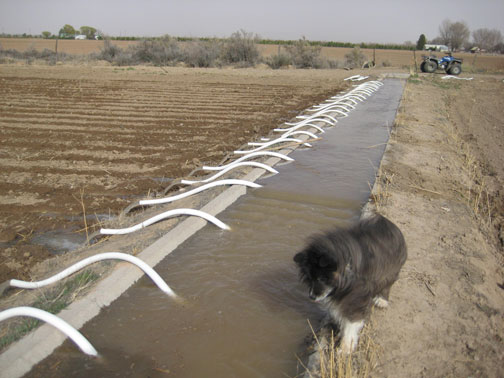
Fuzzy loves to help, he spends lots of time barking at bubbles, trying to catch sticks and sometimes jumping in and wading.
7. The irrigator has to follow the water down each row, making sure it doesn’t plug up, sink in a hole, cut over into another row until it gets to the end of the row. 5 acres is a job, 30 acres a pain, and 50 acres horribly hard. We farm 80+ acres. The water only has to be walked if the leveling job is not good (that’s why I say it is an art form). Then we only have to walk until the row is imprinted with the memory of the water, after that it is sealed. BUT….once Terry cultivates we have to start over again. Then when the crops get too big to get the tractor through the field the water just has to make what way it can, hopefully the imprint is firm and we don’t have to worry.
Maybe you can see the subbing taking place in the below photo.

There is more, but this gets the water started for the season.
 Life on a Colorado Farm
Wow that looks like a lot of work!
LikeLike
I think I got it..but hey I used to be blonde..30 to 40 tubes per field.. the tubes must have to be moved alot..The irrigator follows the rows?? The “subbing” ..that must be the flow of water makeing its way down the row to the other end of the field? Then I am lost on the imprint..??
“Then we only have to walk until the row is imprinted with the memory of the water, after that it is sealed.”
And to top it all off you have to pay for water.. my goodness sakes..what happens if it rains? I saw some water in ditches like yours in Oregon and Idaho one year..maybe Utah also..I could never quite figure it all out. I am sorry to be a pain.. but I find it very interesting.
Here we have small farmers who just rely on the good Lord for enough rain or Corporate Farmers with big old circle pivot irrigators..and that water comes from deep wells. Some medium sized farmers get their water from a local river..but that water usually causes lots of clogs in the irrigator. The irrigators go here, all day everyday even in the rain, if it rains for more than two days they shut them off. They even irrigate the highways and gravel roads if the wind gets to blowing..a real waste of water.
Anyway I did enjoy your post today! 🙂
LikeLike
Facinating! So this is where the term Ditch Diggers comes from?? 🙂
LikeLike
It is very interesting to see how it all works. That is a lot of work. How about your ancestors (since you are interested and have done research) can you imagine how hard they worked and mostly relied on rain.
LikeLike
Fuzzy is so helpful. Once again, this farming stuff seems like a lot of work. Terry must love it.
LikeLike
I can’t thank you enough for this series! I am learning a lot. What a tremendous job this seems to be…for 80 whole acres
LikeLike
I have so enjoyed reading your “step” series on farming. Not quite time to start farming here in Southern Maine, but we’re getting there!
LikeLike
A great post on irrigation. The Bossman always wanted to get to chase water but never has. I worked for an irrigated outfit in my younger days and had my fill thankyou very much 😉
LikeLike
Now that is truly an education on the VALUE of water in your farming operation. I cannot even imagine paying for water…..and paying even more than your taxes are!
If that was a farming expense for us, we’d be OUT, DONE, GONE in short time. Our taxes which include County and Township Road taxes and School Taxes are astronomical here and becoming a burden, since we are now retired.
Thank you for the pictures!
Keep on Keeping on….a Mantra for all! LOL
LikeLike
Oh my goodness, I had no idea that it was such a huge job. That really looks like a lot of work, I don’t think I will take our rain for granted again… Thank’s for sharing this, I have learned alot so far. Whats next?
LikeLike
Wow, great explanation – I know nothing about irrigation. What a job.
LikeLike
WOW, that is a LOT of work and a LOT of acreage!!
I can’t thank you enough for explaining all of this with pictures, I am really enjoying learning all about farming.
Oh, and I just love Fuzzy!!!
LikeLike
In Northern Maine where the main crop is potatoes they do utilize an irrigation system. Here in Southern Maine they irrigate sod farms, but to my knowledge,not dairy farms.
LikeLike
Amazing. What a lot of work! A farmer’s life is not an easy one. How long does the water run before ‘they’ cut it off?
LikeLike
I’ve been reading your story “backwards” starting with your newest post first and it’s really amazing to see all the hard work and forethought that has gone into your fields. My hat is off to your family.
LikeLike