WHAT’S IN THE MUSEUM
The Tom McCarty Autobiography Manuscript
Researched by Jim Wetzel
Tom McCarty, the outlaw, was said to have dictated his autobiography in 1898. Some say, or speculate, that he did this from a location in Robbers Roost, a well known refuge for outlaws in southern Utah. It was one of the rare times that Tom McCarty was heard from following his failed robbery of Delta’s Farmers & Merchants Bank in 1893.
Historian Charles Kelly, (1889 – 1971) claimed that the original 93 page typed manuscript came into his hands from Tom McCarty’s son, Thomas Leonard McCarty, born in 1878. Charles Kelly did most of his research in Utah, and he wrote several books and many historical articles, mostly before 1940. His book, The Outlaw Trail, was first published in 1938. At that time, some of the western outlaws he wrote about were still alive, or at least had friends who were. And when people were still around who could add to, or correct historical writings such as Kelly’s, they often did not, for fear of family retribution by those written about. However, Charles Kelly did receive many letters and notes filling in the blanks, or adding to writings that were already in public hands
Kelly got so much additional information over the next 20 years that he republished The Outlaw Trail in 1959, with nationwide distribution this time. This is one of the most important pieces of western history simply because Kelly knew many of the characters in his book, especially Robert Leroy Parker (Butch Cassidy), the main focus of his book. And it is original research, not copied and altered from some other writer.
Charles Kelly claimed that the McCarty manuscript was first published around 1898, in Manti, Utah, though there is no record as to what form it was published. Kelly claims that it was published by Matt Warner’s father, Christian Christiansen. Matt Warner used two different aliases. His given name was Willard Erastus Christiansen. He was also known as Ras Lewis, and of course, Matt Warner.
Even though the Manti Messenger, Manti’s newspaper in 1898, has been digitized, and can be viewed online through the Utah Digitized Newspapers web site, I have not, thus far, located any reference to the manuscript in select 1898 editions.
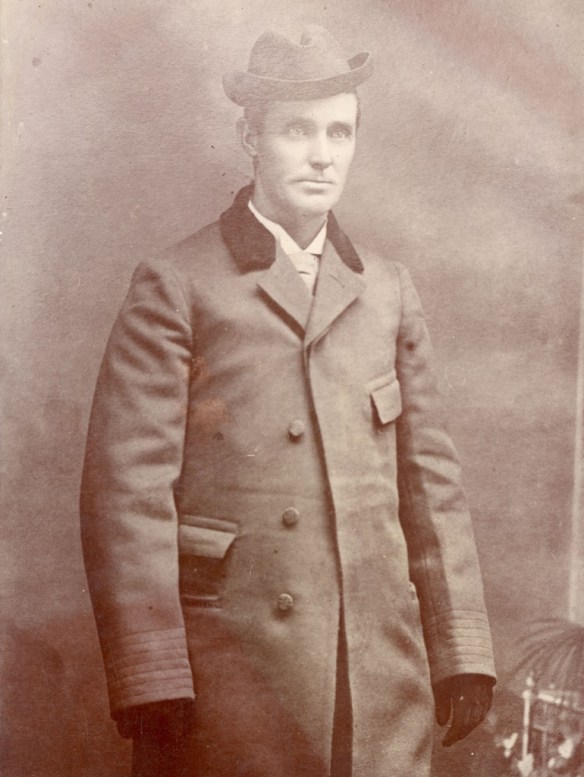
This classic photo of Tom McCarty is the one in the police Rogues Gallery in Salt Lake City. Many copies of it are in circulation.
Some outlaws, for whatever reason, took credit for crimes they had nothing to do with. Tom McCarty, on the other hand, denied that he was involved in robberies that he did, in fact, participate in, such as his well-known complicity in the robbery of the David Moffat bank in Denver in 1889. Just the fact that his manuscript is original source material makes it historically significant, especially since it was written within a decade or less of the events he described.
By the same token, Matt Warner’s autobiography, titled Last of the Bandit Riders, falls into the same category. Warner wrote his memoirs over 40 years after the fact, suggesting probable inaccuracies, verified by a number of historians. Copies of this book are rare and pricey, but they can be found on the internet. Several years ago (2000), writer Steve Lacy from Salt Lake City, in collaboration with Matt Warner’s daughter, Joyce, republished Matt’s book, and called it, Last of the Bandit Riders – Revisited. According to Lacy, he corrected some material, and added other, including some photographs and letters supplied by Matt Warner’s daughter.
When Charles Kelly acquired the 93 page McCarty manuscript, he had it re-typed and two copies were made. He sent one copy to the Utah State Historical Society, probably around 1949, or earlier. The USHS records do not reflect the donation date, but the Skovlin book, In Pursuit of the McCarty’s, refers to a meeting between Charles Kelly and Thomas L. McCarty that year. The Delta County Historical Society acquired a copy of the McCarty manuscript from the USHS in 1969. The museum copy is 100 pages, double spaced. In the front of the manuscript are some notes written by Charles Kelly which relate to parts of the manuscript text. He attempts to fill in a few blanks, or clarify a few entries. When Tom McCarty wrote his autobiography, he intentionally omitted dates and names, but did give clues. For places like Delta, he would write “D—-“; for his brother, he would write “a relative”, etc.
I have read Tom McCarty’s manuscript. It is an interesting read, even though I feel he did not accurately portray the Delta bank robbery. This will become apparent when my book on the subject is published this year. I could elaborate on this, but I don’t want to spoil the book experience.
Most of the information above was obtained from the Introduction to Charles Kelly’s book, The Outlaw Trail, and from the book version of the McCarty manuscript, published in a limited edition in 1986. The Delta County Museum sells the updated version of Kelly’s book, first published in 1959, and again in 1996.
 Life on a Colorado Farm
I love your museum posts! Small town museums had so much to offer!
LikeLike
When the West was really wild, nice to see this historical information archived.
LikeLike
Great article Jim Wetzel ! I appreciate your research and then communicating this knowledge to us.Thanks for posting it Linda.
LikeLike
Thanks for sharing. Such an interesting story. I love how it is expected that inaccuracies will occur once a certain amount of time has passed. I can seldom remember what I had for lunch yesterday, but I suppose robbing a back would leave a greater impression ones mind than a Subway sandwich.
LikeLike
A great post…really enjoyed it! Thanks for sharing….I must admit I had not heard of this outlaw, but sure enjoyed reading about him and his family.
Blessings!
LikeLike
I have a signed letter signed by matt warner western outlaw what is its value
LikeLike