Since we had a really bad problem with coyotes a year or so ago, we talked to a Government Trapper (yes, there really is such a person). Remember the information below is FROM THE GOVERNMENT TRAPPER, I am NOT an Expert!!!
Please do NOT send me horrible emails telling me I don’t know what I’m talking about…I only have my experience and what the expert has told us.
A couple of times Terry was actually stalked by a coyote—probably defending the den, while he was changing water late in the evening……and once the dogs and I were stalked.
We have had coyotes come into the yard….sending in Missey Coyote to lure the dogs out so they can …well…have killing sport with the dogs.
We have had to train the grandchildren not to run around on back of the farm in the late evening…ever!
I never leave dog food or cat food outside, nor do we throw scraps out for the hens, all scraps are in a pan in the hen house.
The dogs do like to sleep outside in the summer and we let them. We also are very diligent to check on everything and everyone the minute we hear anything out of the ordinary.
The other thing we have here are very stupid people who dump their dogs off, thinking they will find a home on the farm. Usually what happens is they gather together and form dog packs. Dog packs are just as bad or maybe worse than coyotes as they love to kill for fun and sport and are NOT in any way afraid of humans since they once lived with humans.
Sometimes the dogs mate with coyotes…then what happens the result is called a cy-dog. Not a good mix.
We also learned some of the language of the coyotes:
Howling – communication with other coyotes in the area. Also, an announcement that “I am here and this is my area.”
Yelping – a celebration or criticism within a small group of coyotes. Often heard during play among pups or young animals.
Bark – The scientific name for coyotes means “barking dog,” Canis latrans. The bark is thought to be a threat display when a coyote is protecting a den or a kill.
Huffing – is usually used for calling pups without making a great deal of noise.
One way to tell if an attack was by a dog or a coyote is to look at the size of their tracks and the spacing of canine tooth punctures. Dogs aren’t known for killing sheep or calves for food and dogs are random in how and where they attack. Coyote tracks have more of an oval shape and seem more compact that a domestic or wild dog tracks.
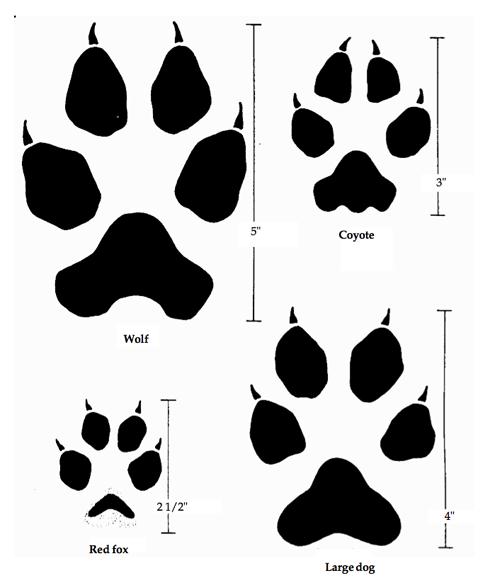
Damage Problems–In the western United States, coyotes are the main predator of domestic sheep, causing significant losses in select areas. They can also prey upon goats, calves, hogs, poultry and watermelons. Coyotes will also kill domestic dogs and house cats. They most often kill larger prey by biting the throat, causing death by suffocation. Coyotes frequently adjust their grip on the prey’s neck, leaving multiple bite marks.
Coyotes may attack fleeing animals from the rear, biting the legs or tail to slow them down. Coyotes typically begin feeding behind the ribs, often eating the stomach of nursing animals. The nose and hindquarters are typically eaten on calves. Coyotes have been known to attack cows in labor, feeding on both the emerging calf and mother.
We have other known predators here…if you ever walk in Confluence Park you will see that we have Mountain lions that move through the area, signs are everywhere informing you of what to do and how to protect yourself if you cross paths with one. We have fox…lots of fox, but they don’t harm cattle. Randomly a bear will wander in, but that is random.
Some of you live in places that have other predators, animals we have never had here or if we did are now gone–like the wolf.
I’m sure you are tired of this subject so this is my last post on on predators for a while. I hope you have found it educational, which is what is intended to be.
Once more, thanks ever so much for stopping by.
Linda

 I have not idea if they sting, what they eat, or anything about them. Although, I do like to randomly drop by and leave bits of table scraps — treats for the hill, so to speak — we leave them alone.


 Life on a Colorado Farm