
Our farm is rented in February to a rancher that likes to ‘calf- out’ on our land. The ‘girls’ get to have lots of neat things to eat the month of their due date: corn, hay, bean straw, weeds and weeds and more weeds and last year’s cattails (which are really yummy).
They do lots of good (about 82 head of moms-to-be) and our tiny group add much needed fertilizer onto the farming ground, and help munch down all the weeds and cattails and prune the sage and Chico brush (just the tips are a delicious treat), getting the farm ready for spring work.
In return the cows get a fairly safe place to have their calves. Randomly we (and the cows) will have a tussle with the coyotes and the calves always loose. Coyotes are sneaky killers waiting for the cow to be in labor and for the calf to be ‘coming out’. Cows can’t see their backside so therefore can’t protect themselves from an attack from either wild dogs or coyotes. As the calf emerges the coyotes drag the baby from the mom and immediately kill and eat it. Sometimes they will take on the mom too. And NO they DO NOT HAVE TO BE HUNGRY TO DO THIS…they just have to want too.

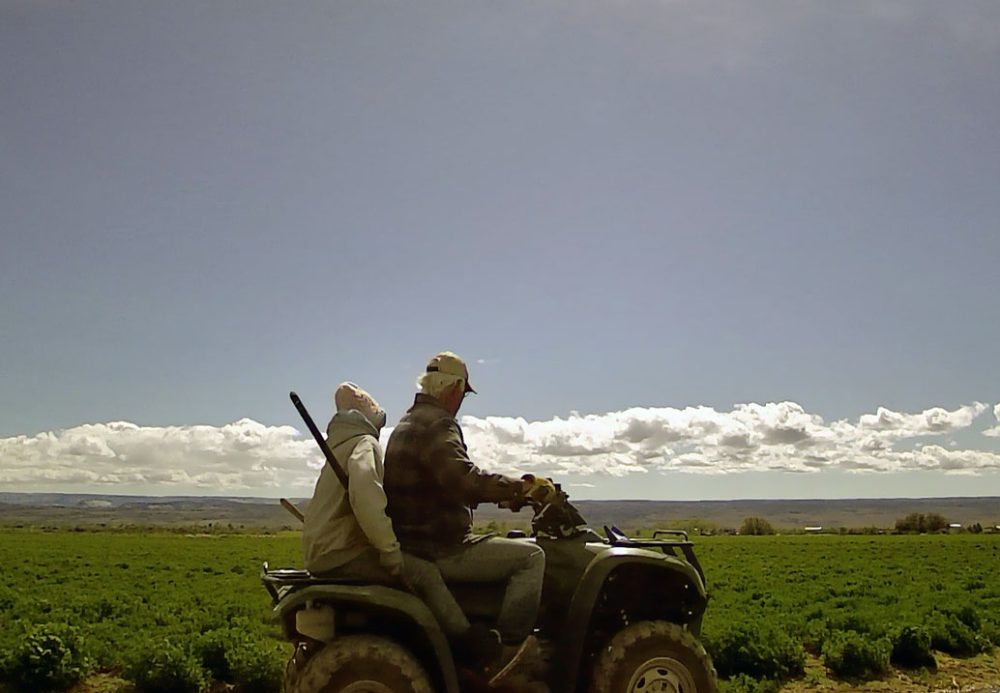
So we all start patrolling the farm, the ranch guys come by, and we go out. It’s important that ‘critters’ stay away….far away…from the maternity ward!
Yes, we have wild dogs….thanks to those PEOPLE who just don’t want a dog anymore and take it to the country hoping it will survive. Most of the time the dogs either—-die, get ran over, or join with the other wild dogs that run the drain ditches and the canyons looking for food. Sometimes we country folk can catch the dogs (like I got Fuzzy) and can make them ours, but most of the time that doesn’t happen.
These animals always hang close to farms BECAUSE THEY WERE ONCE RAISED IN A FAMILY OF PEOPLE and kill livestock for fun/pleasure and Food.
Raising animals and being a good protector of those in your care is a full-time job. I would hate to meet someone who lived on our farm in the bye-and-bye and have them say I didn’t do a very good job. Makes me sad to even think that could happen.
So anyway, the girls are back. These are the great-great-great granddaughters of cows that have been coming to our maternity ward for years and years.
It’s always good to see them again.
Linda
 Life on a Colorado Farm
Exceedlingly informative Linda. Your coyotes are like our dingoes here in Australia. As for the ‘feral’ dogs, the less said the better.
I often wonder who/which is worse, the ex-owner or the dog.
Those cattle which are brought to lowlands, like your ranch for calving, what breed are they? They look like they have Charolais, the heavy French cream coloured, blood in them. If so, and are crossed with shorthorns, herefords or aberdeen angus, they produce very sturdy stock of excellent quality beef. It is only in about the last 40 odd years that this breed has been introduced into Australian herds.
Are these cows when the calving is over and the snow has gone, are they then returned to the mountains regions?
Great reporting Linda
Cheers
Colin
LikeLike
I am not completely sure. At one point he was working with Limousins and Charolais. They throw very large calves, which can be extremely hard on the moms. He started mixing some short-horn and Saler. But still leans heavy toward Charolais.
When calving is over and we start plowing, they go to another pasture located about a mile from our house. Here they will continue to stay until about May. Then they will be turned into the river pasture, which is about another mile from where they will go.
They will stay there until the snow melts on 25 Mesa. About June. Then they will go to the middle ranch called the spring/fall ranch while the snow melts on top of the mesa. After the snow and the mud are gone and the grass gets to growing well, the cattle will go to the summer ranch.
The first snow fall (on top) brings the cattle down to the middle ranch, when snow gets deep there, they come home to the winter ranch. Once at the winter ranch the cattle are separated into groups, and gradually the soon-to-be Mommas come to our farm.
Then it starts all over again.
As an FYI-The rancher on the other side of our farm, the one with my Friend, those cattle are brangus and beefmaster mix.
LikeLike
Those are good looking mommas. Keep them safe. and best wishes for a bumper crop of calves.
LikeLike
Very intersting, Linda, about how the cows move from farm to farm. It sounds like it’s all on a schedule. We are considering fencing our property and renting out some fields, but I don’t think we have nearly the fields that you have. Our property is mostly forests, which is nice, too. Maybe this summer we’ll work on our fences… For now I will enjoy watching your mommas-to-be. Good luck keeping the coyotes away!
LikeLike
Very intersting, Linda, about how the cows move from farm to farm. It sounds like it’s all on a schedule. We are considering fencing our property and renting out some fields, but I don’t think we have nearly the fields that you have. Our property is mostly forests, which is nice, too. Maybe this summer we’ll work on our fences… For now I will enjoy watching your mommas-to-be. Good luck keeping the coyotes away!
You are so right! Everything is always scheduled. All the ranchers (those that have property in the mountains) try to calve out starting in February. Sometimes a rancher chooses January, but most want February. The reason for February is by the time the grass is green in the mountains the calves are sturdy and strong enough to walk to the long distance, or in some cases, to ride in the semi’s and not become ill.
For us we calve in March and April. I favor April, Terry favors March. We are not in a hurry to transport anyone because they live right on the farm with us. We have several acres that are not farmable, but are perfect for grazing and have delightful Chico stands and sagebrush hills that the cows relish. We also have two lovely pastures and three watering areas with delicious cattails. They help us and we help them. They come in daily to the corral for a flake or two of hay or a little grain. Therefore, our cows are free ranged and grass fed.
Linda
LikeLike
Poor Mamas…why don’t the other ladies kick a coyote or two if it is attacking?
Do you have to have people out at night patrolling…. or do they sleep in a barn (I know…dumb question). Anyway…that was very educational.
LikeLike
Poor Mamas…why don’t the other ladies kick a coyote or two if it is attacking?
Do you have to have people out at night patrolling…. or do they sleep in a barn (I know…dumb question). Anyway…that was very educational.
Most cows are just like women and want a little privacy. Since ours are free-range, and all the cows around us are free-range, they will head to a spot (like a Chico brush or sage brush area) or behind a building, or someone a little ways away from the other mothers. You know, away from prying eyes.
If the cow suddenly has a birth in the middle of the herd, just like any woman, calf come when they want to, the of course the guard cows would be present. But sudden births are, well sudden, and being where the cow doesn’t feel comfortable is not the preferred choice.
Yes we check and the rancher checks all the time, day and night, morning and evening. We usually do the day time, because they are not our cows, and he and his family does the night time because they are his cows.
We try to help, that is what friends are for. 🙂
Linda
LikeLike
Does the farmer have the cows calve outside as a way of culling the cows and caves that are not as hardy as the others and don’t survive, or is it healthier to calve outdoors, or? Are there guard dogs or people that stay with the cows when they begin to calve? This is all very interesting.
LikeLike
Comment:
Does the farmer have the cows calve outside as a way of culling the cows and caves that are not as hardy as the others and don’t survive, or is it healthier to calve outdoors, or? Are there guard dogs or people that stay with the cows when they begin to calve? This is all very interesting.
In Colorado, our part anyway, all calving is done outside. It’s a very serious problem when you have to take a cow to the barn so she can calve. Culling is done in a very humane way, not just allowing the ‘wild beasts’ to kill them. Farmers and ranchers are always watching and being with their herds, large or small herds. You get to know the animals; you take care of them and treat them with respect. We have very, very, FEW feedlots. I only know of 2 and they are really holding pens.
Everyone here is pretty old-fashioned preferring to allow the grazing animal to graze. Because they are allowed to graze sickness isn’t as much of a problem. For instance cows trapped in a feed lot will develop breathing issues, feet/hoof problems, and eye diseases, plus many, many other stuff which requires medicine.
Most farmers and ranchers try very, very hard to have extremely healthy and sturdy stock so not one head is ever lost. The goal is to NOT loose animals. Sometimes, though, something will happen whereby you do lose someone. For instance the cow lies down while having the calf (they are just like all animals and become very uncomfortable so they get up and they get down and they walk and they moo.) Sometimes they lie down and squirm and land themselves upside down and can’t get up, they will die there and the calf can too if someone isn’t watching and helps the many, many pounds of momma to right herself.
Some ranchers ALWAYS pull the calf, just like some Doctors always pull the baby, but we don’t and all the people we are connected to don’t. The only time would be if the calf is breach and you can’t get the calf to turn.
Just like women in any species cows can prolapsed which if VERY serious so we all try to be close by. At one point we had a cow that prolapsed, after having her calf in a ditch, at 1:00 in the morning, in a snow/rain storm. What a huge frightening time. Everyone survived and the calf went on to get Reserve Champion at the county fair. But it was a very long night for all involved. That night the momma and the baby went to live in the barn and stayed there for a week. Easier on us and on them.
Anyway, I could write a book. Just know that we ALL try to be very good caretakers of our animals and give them the very best of lives.
(And no one EVER wants to call in a predator for they don’t stop with the sick or the maimed they kill all no matter what state of health they are in. And they will come right in the yard and take on your dog and cats and children. Predators are predators.)
Thanks for asking,
Linda
LikeLike
Ewwww…..says the vegetarian.
I am certainly glad I gave birth in a hospital.
LikeLike
A sign of spring coming!!!
LikeLike
I hate people who dump animals. Their unwanted problem just becomes someone else’s. I haven’t noticed to many dumped dogs around by our place. Usually we just get the dumped cats. I didn’t know that wild dogs and coyotes could be so dangerous to your herd of animals.
LikeLike
Those cootes and wild dogs are a menace. Hope the girls manage to save all their babies with human help.
LikeLike
A most fascinating story and a great way to fully use the land. I’ve never heard of a chico bush before, but I’m glad the cows enjoy it. I certainly know what you mean about the coyotes and feral dogs. We certainly never realized the extent of the coyote presence here in our corner of North Texas. When we lived in the city we never gave them more than a second thought, but since moving to the country we’ve come to appreciate how much of a threat they are to our critters. Their howling out beyond the fencelines chills my blood, but our Great Pyr beasties keep them at bay. Those big boys all 100+ pounds of them by now stay with the flock at night and I’m convinced deter just by that deep barking. A close friend of my DW’s lost a couple of prized sheep to some stray dogs, but she had inadequate fencing and no LGDs. Anyway, as seems to be always the case when I stop by the blog, I learn something interesting and view some nice pictures. Thanks.
LikeLike
Can’t wait to see the babies when they come. I hear ya on patrolling the fences. Coyotes and feral dogs do love it when calving comes. Feral dogs down here often chew the ears off the calves, sometimes literally as they’re being born. Horrible thing to see, and I understand ranchers wanting to protect their livestock from that for sure. Sounds like the problem happens up there too.
LikeLike
Hi Linda, This is so cool the way the cows go from farm to farm-I guess like the sheep do up here in northern Colorado. I hope you’ve had a break from the snow. It has to be intimidating to have wild dogs roaming the farms like that.
I sent you an email yesterday, hope you got it.
Have a wonderful warm week.
Hugs, Noreen
LikeLike
Wish I could send you a few Hanks to help out. Neat about the generations of cows.
LikeLike
I hope this year all the calves make it and can’t wait to see the newborn photos!
LikeLike
I know what you mean about coyotes. We have quite a lot of them around here and have lost quite a few pets, chickens and ducks. And the bobcats are also a problem. Hope you can keep them all away. blessings,Kathleen
LikeLike
What a great thing to get to behold. I still remember as a young child hiding in the feeding trough to watch a sheep give birth. I sure hope with all the latest buzz about being green and sustainable that more farmers begin to use approaches like you do to healthier (is that the word?) farming.
LikeLike
Kathleen wrote: “I know what you mean about coyotes. We have quite a lot of them around here and have lost quite a few pets, chickens and ducks. And the bobcats are also a problem. Hope you can keep them all away. blessings,Kathleen”
We don’t have bobcats, but we do have the occasional mountain lion or bear.
A predator is a predator always. One to treat with respect and caution.
Linda
LikeLike
We once visited a farm that had alot of different kinds of critters, they used gelded llama’s around the perimeter for protection against coyotes. I hope you post pictures as babies start to arrive:) Blast those negligent pet owners!!
LikeLike
Hi Linda, Love your maternity ward..nothing better than getting to watch baby calves. How about Donkeys? Would one help to keep the coyotes away? Llamas are pretty cool too! We have a bunch of coyotes and wolves in this area..not many cows anymore..:)
LikeLike