Of course you have to hook everything up to the tractor. Terry likes to use the 730 to pull the beans
 That thing on the front is the bean puller…here’s a better photo of it

Then the bean blade
 The puller lifts the beans up and the blade cuts them off
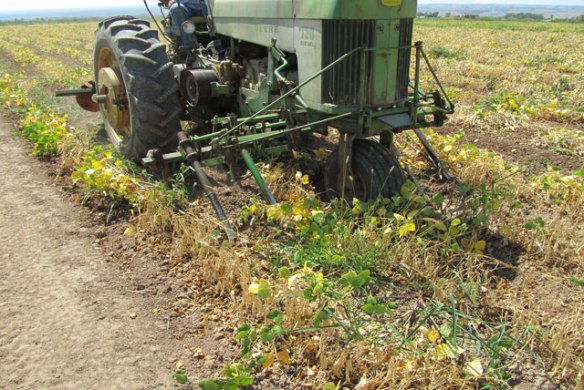
Moving down the field everything is pushed together into rows
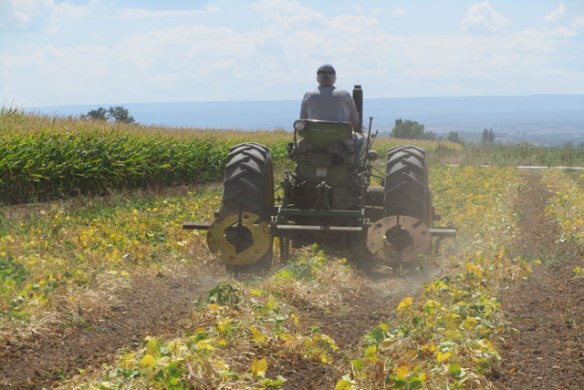 The rows are allowed to dry for week (unless it rains, then a mess occurs)
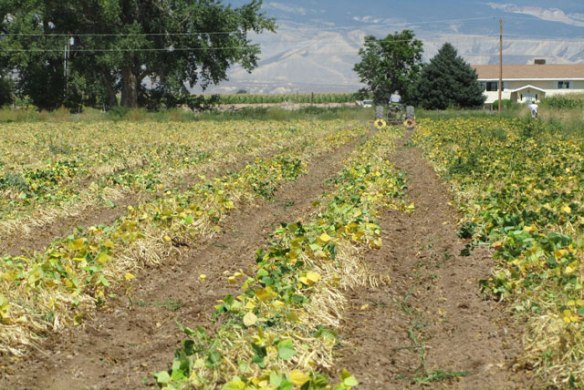
All pulling of the beans occurs in the morning, while the dew is still on the plants. If you look you can see how dry the bean pods look. They are very dry. A little dew holds the pods together so they don’t shatter and spill the beans into the ground. If a pod shatters and the beans spill, that is then end. There is not a way to pick up the beans from the dirt.
After a week. It’s time to start combining. Combining is ALWAYS after lunch. You don’t want the plants to be wet and clump in the combine and cause a wad mess. You also don’t want wet beans going into the combine and molding. If you deliver wet beans to the beanery (where they sort, sack, and sell the beans) they will refuse your load.
For a farmer that is money and time lost.
Dry beans for the combine only!
 We are not big farmers and our equipment is not new, but it is paid for and Terry knows how to fix it if something goes wrong. He also has a small combine herd of combines that he uses for parts since our stuff is really dated.
 Here the combine is picking up two rows of a time and shelling them and putting the beans in the hopper
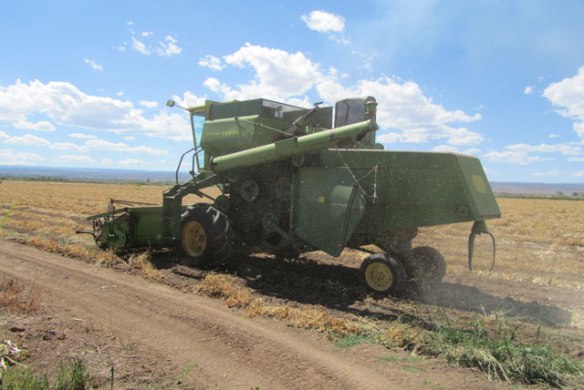
The weeds and the bean straw is flung out the back

Leaving just the straw behind.

Once the day turns to evening and the cool comes on, the farmer must stop. Lots of time the lights run until the operator just gets too tired and calls it a day.
The hopper of the combine is dumped into the bin of the grain truck

When the truck is full, but no over flowing it will be driven to the beanery about 5 miles from our home. The trash you see in the beans (weed leaves that made through the trasher into the beans) will be screened out. Then the beans are sacked ready for market.
But first….we got to get them there!
After we get done with the pintos our next crop to harvest will be the corn. But that won’t be until the end of September.
Linda
 Life on a Colorado Farm
That is so interesting and I would love to actually watch the whole process and in the beanery. It looks like you have a good crop. How’s the corn crop look?
LikeLike
All you talk of beans made me make a pot last night. I love them in so many ways–last night with hamhocks, later in burritos.
LikeLike
Fascinating! Thank you for sharing.
LikeLike
My brother got all the corn and wheat in before Isaac hit (NE Louisiana), but they didn’t get as much rain as they feared, only about 4 inches. Lots of wind though, so I’m glad they got the wheat in. Soybeans were still a little too damp when I was there over the weekend, hoping they dried out so they could cut them.
LikeLike
Hey, thanks for this! I know you did it just for me. It is a fascinating procedure. I really like that old 730. It was the old two cylinder with the big fly wheel. In the old days before starters you turned the fly wheel to start the engine. You made my day!
LikeLike
This was a really interesting post. thanks for sharing how you harvest the beans and explaining all the equipment.
LikeLike
As a city girl with a little garden, I always wondered how the beans were harvested. Thank you for sharing it with us.
Judi
Author of “Trail Training for the Horse and Rider” and “Trail Horse Adventures and Advice”
LikeLike
That is one big load of beans! Glad they all got harvested at the right times and the weather cooperated.
LikeLike
Many thanks Linda for the great sequence of photos on harvesting pinto beans.
I have been sitting here (6.30am Thursday 6th) going through the steps of the harvest.
It sure is a long process and so much appears to depend on the weather co-operating.
Seems so far everything is going to plan.I have seen variously named varieties on
supermarket shelves. I must confess so far I haven’t bought any. I’ll have another
study today of what I can do with them. I am sure that I must have eaten them somewhere
in a spanish or mexican restaurant?????
Cheers
Colin (Brisbane.Australia)
LikeLike
Thanks for sharing the step-by-step process. I had no clue! It must be very satisfying to see the piles of beans.
LikeLike
What a great post, Linda. Good luck and God bless your efforts. ♥
LikeLike
Awesome, we don’t have new equipment either and sometimes the older ones run better and are a lot easier to fix!
LikeLike
Once again, I learned a lot!! When my dad was selling John Deere equipment, he carried tools and coveralls in his truck. He could fix lots of things on those big green machines. They became so complex that the coveralls and tools went to the shed. I love to hear that Terry can fix combines with parts from the old machines. Hope the corn harvest goes as well. If I was home, I might need a pot of pintos!! Linda, on Nana’s computer
LikeLike
That’s some sort of modern way of farming. We’re still doing the old way. Especially in some places here in the Philippines where carabao and manual labor where still used. Only those who can afford use like your way.
LikeLike
I never fail to be amazed at the skills a farmer needs. A lovely post, thank you Linda. So glad the weather was right for you.
LikeLike
I love this post! Always wondered how beans were shelled en mass. It’s absolutely amazing to me that a machine that large can shell the tiniest of pods eithout shattering its contents.
We are getting lots of beans here from the ones you sent. Looks like our dry streak is going to end though, so i may have to pull early. We’ll see. Can you believe that Seattle hasn’t had rain in over 45 days?
Good luck with the corn harvest!
LikeLike
I did not know what was involved with this crop and harvesting outside of the combine. Now I do. A post this long takes some effort. Thanks for that. Many will be wiser for it.
LikeLike
Great post, Linda! I love learning about how things are done! You guys are so important to the world, and I know it gets harder every year to keep moving forward with your banner held high!
LikeLike
Really interesting! You do such a good job.
LikeLike
Interesting Linda..I hope harvest goes well:)
LikeLike
We have a 6 row John Deere bean puller for sale. Reese, Michigan 989-274-8801
LikeLike
im looking for second handpinto beans harvester
LikeLike